
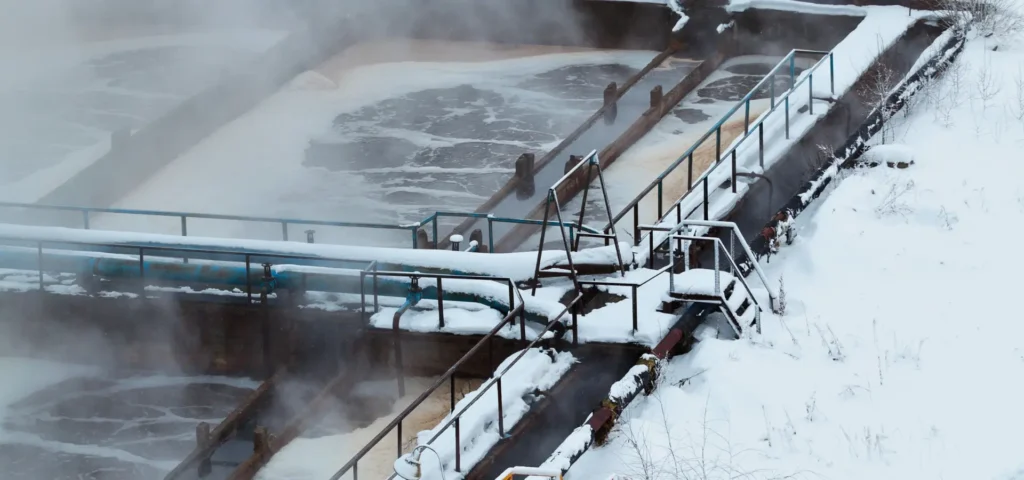
Temperature changes are often underestimated in wastewater treatment plants. However, especially during winter months, lower water temperatures are one of the most important factors directly affecting biological treatment performance.
Many operators realize the issue too late and ask:
Why does an MBBR system that works well in summer fail to deliver the same performance in winter?
The answer is not only bacteria.
The real answer includes:
- Microbial kinetics
- Oxygen transfer
- Biofilm behavior
- Media design
- Hydraulic management
In this article, we explore why MBBR systems struggle in low temperatures and why choosing the right media becomes even more critical.
1. Biological Activity Slows Down at Low Temperatures
As temperature drops, microbial metabolism slows down.
The result:
- Slower COD removal
- Significant reduction in nitrification
- Higher ammonia in effluent
- Longer reaction times
Nitrifying bacteria are especially sensitive to cold conditions.
That is why systems operating below 10°C require a different design and operating approach.
2. Why MBBR Systems Have an Advantage
In activated sludge systems, low temperatures often create biomass loss and sludge age problems.
In MBBR systems, biomass remains attached to the media, which provides:
- More stable microbial populations
- Better retention of nitrifiers
- Higher resistance to shock loading
- Lower risk of biomass washout
For this reason, MBBR is a strong solution for cold-climate applications.
3. Media Design Becomes More Important in Winter
Because microbial growth slows in cold water, retaining existing biomass becomes critical.
This is where media design matters.
Protected Surface Area
Well-designed internal structures:
- Protect bacteria from shear stress
- Retain slow-growing biomass
Uniform Movement
Cold water changes viscosity and can influence mixing behavior.
The right media should:
- Move continuously
- Prevent dead zones
- Maintain contact efficiency
Resistance to Clogging
Thicker biofilm combined with lower activity can create fouling issues in poor media designs.
4. How Oxygen Transfer Changes in Winter
Interestingly, oxygen solubility increases in colder water.
But this alone does not guarantee better treatment.
Because:
- Diffusion rates may decrease
- Internal transport through biofilm slows
- Nitrification still requires strong oxygen transfer
So:
Higher dissolved oxygen potential does not automatically mean better process performance.
Aeration strategy remains critical.
5. Hydraulic Retention Time May Need Reassessment
A reactor volume that performs well in summer may become insufficient in winter.
Why?
Because biological reactions slow down.
During colder periods, operators may need:
- Flow equalization
- Parallel reactor operation
- Load reduction strategies
- Return flow optimization
Seasonal process control is often the difference between stable and unstable operation.
6. Signs Your System Is Struggling in Winter
Watch for these symptoms:
- Rising ammonia in effluent
- Nitrite accumulation
- Longer blower runtime
- Fluctuating effluent quality
- Increased energy consumption
The problem is not always equipment.
Often, it is lack of process adaptation.
7. How to Build a Winter-Ready MBBR System
High-performing plants typically apply:
- Seasonal loading analysis
- Oxygen trend monitoring
- Media fill ratio checks
- Nitrification capacity testing
- Preventive maintenance planning
They manage winter before winter becomes a problem.
Conclusion
MBBR systems have strong performance potential in low temperatures. But it does not happen automatically.
Success requires:
- Proper media design
- Effective oxygen transfer
- Seasonal process management
- Stable biofilm retention
Designing a system that works in summer is easy.
Real engineering is designing one that also works in winter.
info@oxy-tech.com.tr
+90 224 251 61 62