
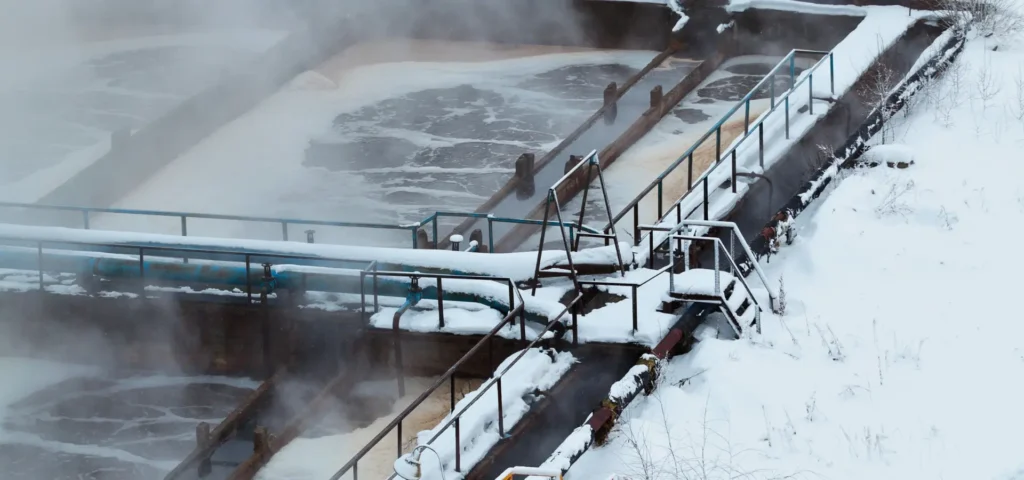

Winter puts real stress on biological treatment. MBBR cold weather operation is therefore a common worry for plant managers. However, a well-designed moving bed biofilm reactor handles low temperatures better than most alternatives. In short, the biofilm stays in the tank even when growth slows down.
Why cold water slows biological treatment
Bacteria slow down as water cools. For example, nitrifiers lose roughly half their activity for every 10 °C drop. As a result, ammonia can break through in January even though the plant ran fine in July.
Heterotrophs cope fairly well. Nitrifiers, on the other hand, suffer most. Therefore, winter design usually focuses on ammonia removal rather than COD.
What MBBR cold weather performance depends on
Several factors decide how well your reactor copes. Above all, the amount of active biofilm surface matters. Moreover, oxygen transfer and mixing stay critical in cold water.
- Water temperature: design for the coldest monthly average, not the annual mean.
- Media surface area: more protected surface gives slow nitrifiers room to grow.
- Fill ratio: extra carriers add capacity without a bigger tank.
- Dissolved oxygen: aim for 3–4 mg/L in winter instead of 2 mg/L.
- Biomass retention: the film holds on, so washout stays low.
Design tips for cold climate MBBR systems
Start with the temperature correction factor. Designers typically apply an Arrhenius coefficient near 1.09 for nitrification. Consequently, a plant at 8 °C needs far more carrier surface than one at 20 °C.
Oversizing the carrier volume is the simplest safeguard. For instance, many northern plants run a 50–60% fill ratio instead of 40%. Additionally, a second reactor stage helps polish ammonia during the coldest weeks. Our guide on MBBR nitrogen removal explains the staging logic in more detail.
Operating an MBBR through winter
Small operating changes protect performance. First, raise the dissolved oxygen setpoint before temperatures drop. Cold water holds more oxygen, yet the biofilm takes it up more slowly. Therefore, a higher setpoint keeps the nitrifying layer fed.
Next, check the aeration grid and the media screens weekly. Ice and thicker biofilm both change how carriers circulate. If the bed stops rolling evenly, clean the diffusers right away. In fact, poor mixing causes more winter upsets than low temperature alone.
Finally, avoid sudden sludge wasting or big flow swings. Cold biomass recovers slowly from shock loads. Similarly, a cold start-up may take six weeks rather than two.
Simple ways to keep heat in the reactor
Tank covers cut heat loss and odour at the same time. Insulated walls help too, especially on small package plants. Moreover, blowers add a little warmth through compressed air. In short, you can often gain two or three degrees cheaply.
Buried or partly buried tanks stay warmer as well. However, they cost more to build. Consequently, most operators start with covers and better aeration control. Even a modest gain protects nitrification during a cold snap.
Monitoring that pays off in winter
Track effluent ammonia at least twice a week. Additionally, log water temperature next to every result. Over time, this simple pairing shows your real temperature limit.
Watch biofilm thickness on the carriers too. A thick, grey layer signals poor oxygen penetration. Meanwhile, a thin golden film usually means healthy nitrification. The US EPA guidance on nitrification offers useful background on the process.
Choosing media for cold climate plants
Carrier geometry matters more when growth runs slow. Look for HDPE carriers with high protected surface area. Furthermore, an open structure keeps channels clear as the film thickens. Oxy-Tech supplies MBBR media that suits exactly these conditions.
In conclusion, MBBR cold weather results come down to surface area, oxygen and steady operation. Plan for the coldest month, and winter stops being a surprise. Contact our team for sizing help on your next cold climate project.